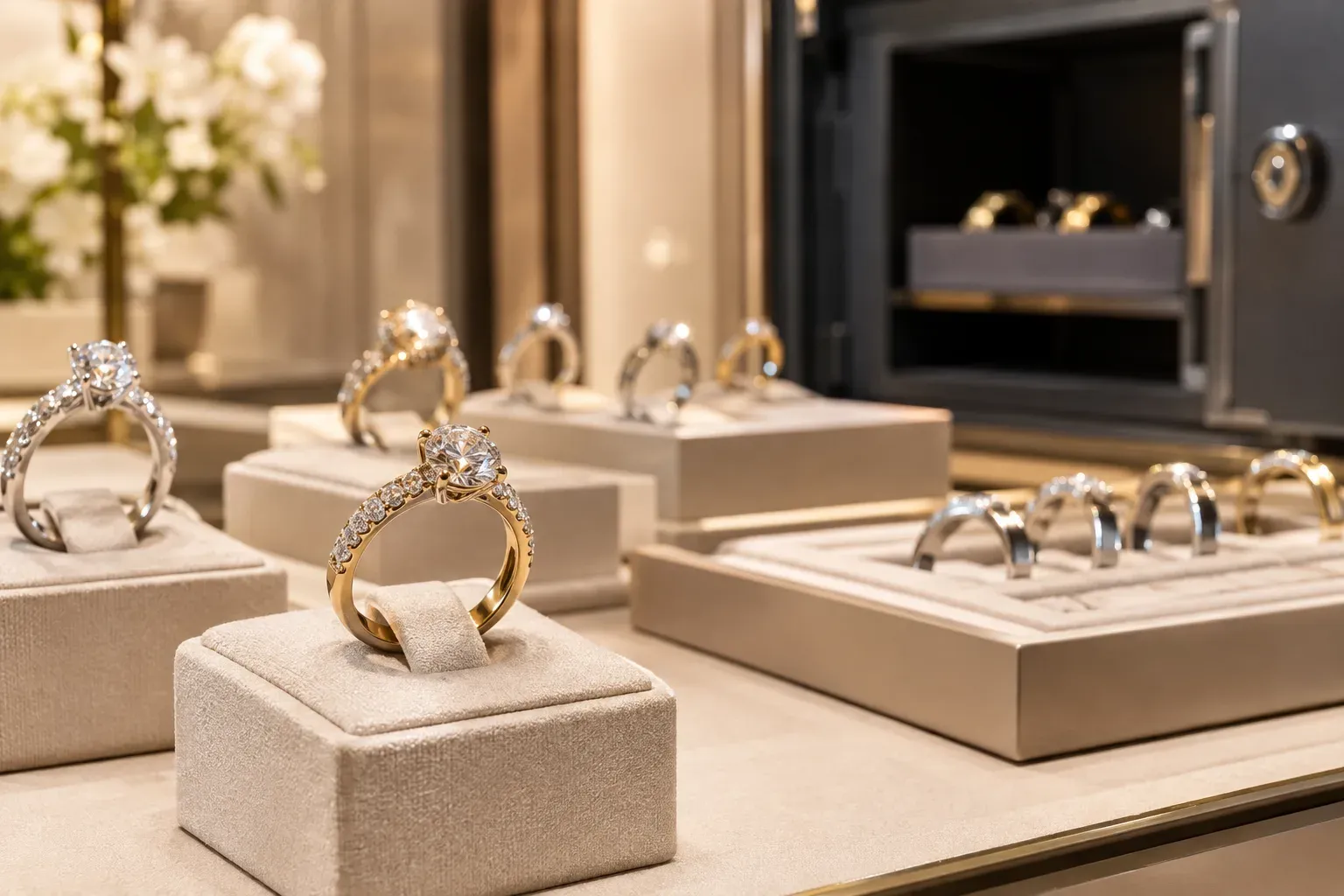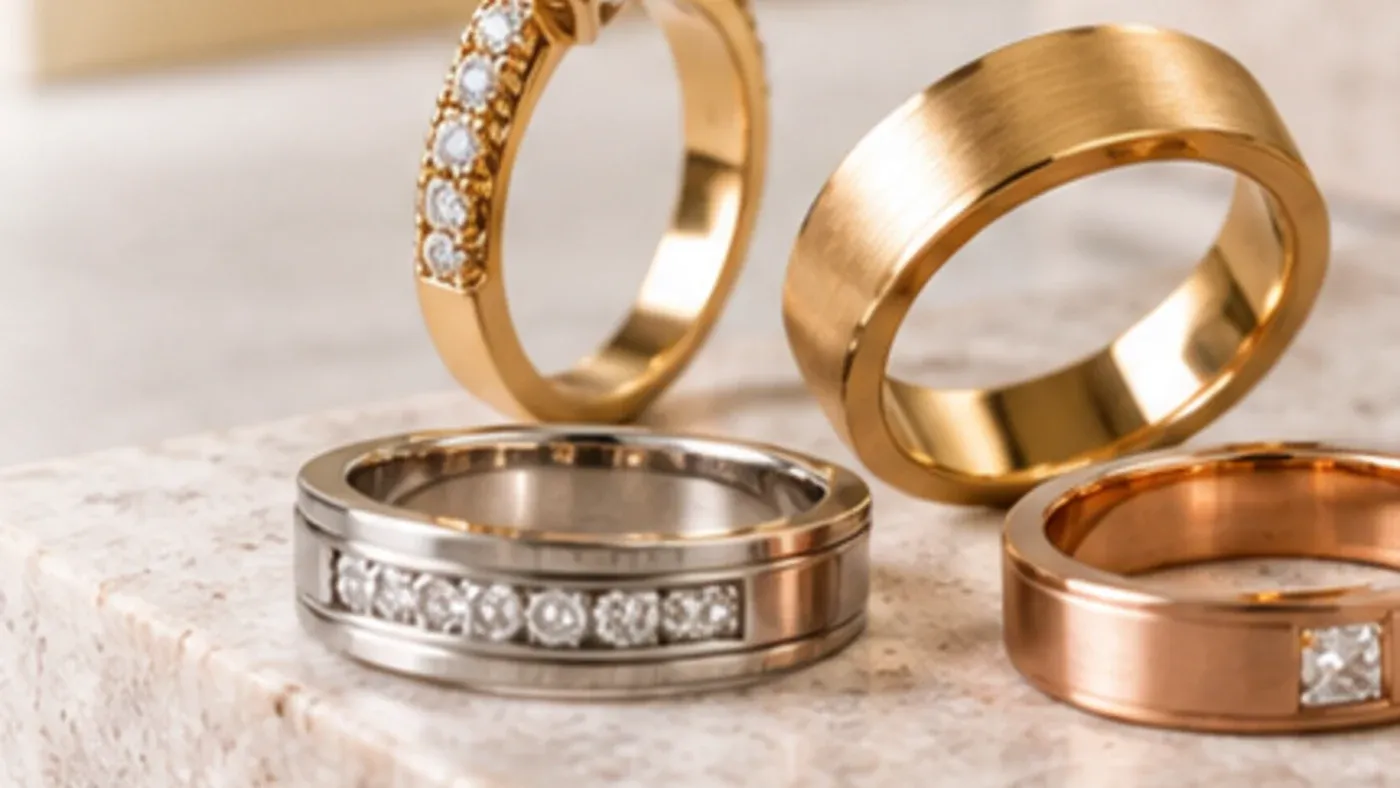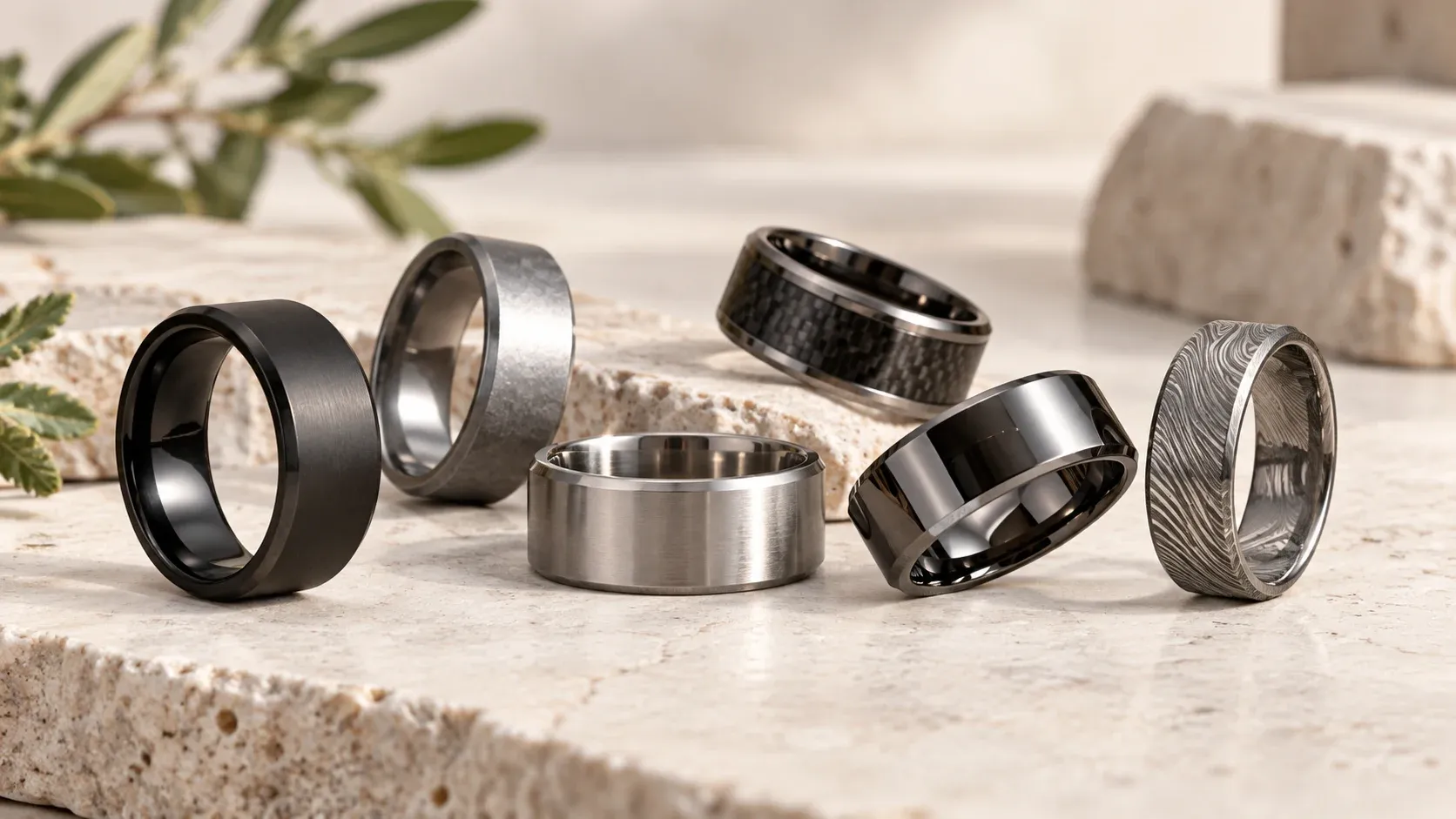
Sourcing Guides
Display Ring Dummies for Gold & Platinum Brands: A Spec Guide
How gold and platinum brands specify brass display ring dummies: base metal, gold-tone colour match, stone setting, finish, sizing 54/64 and engraving.
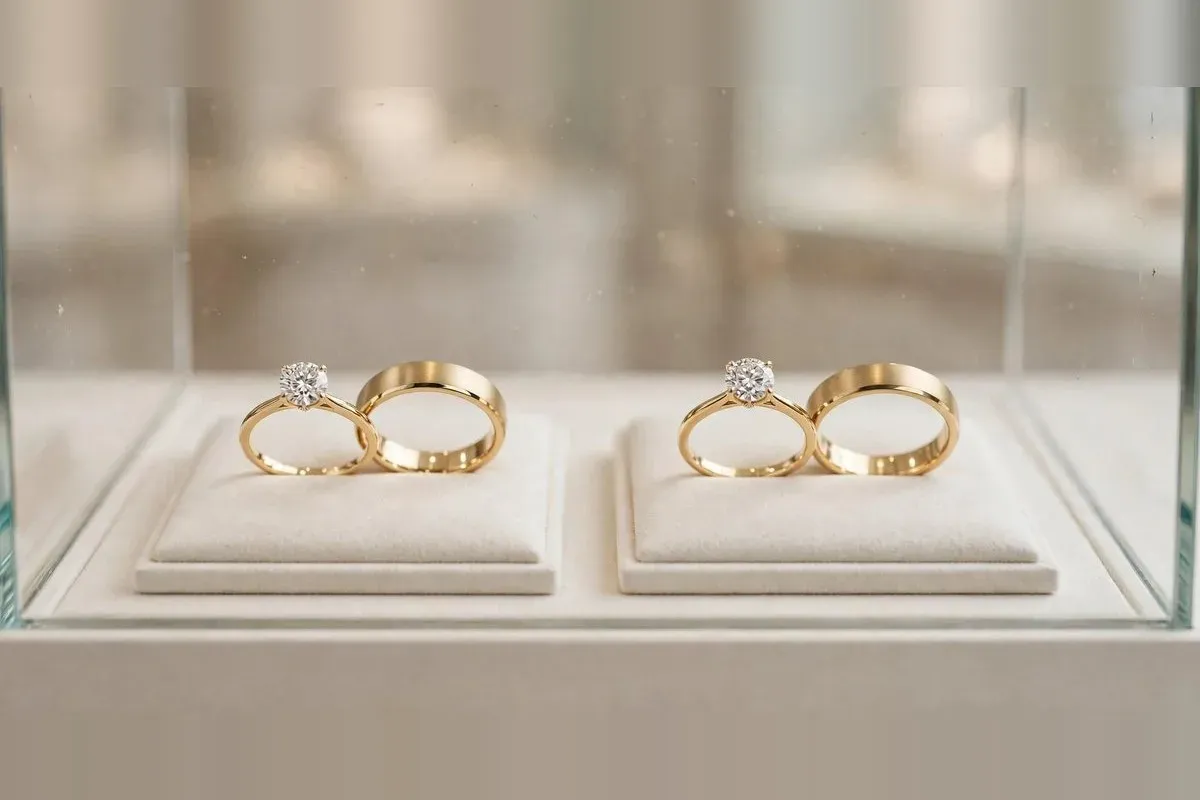
Quick answer: A display ring dummy — also called a display ring or dummy ring — is a non-precious-metal replica of a real gold or platinum ring, made for display, try-on, photography and dealer distribution. Most fine jewellery brands today specify brass as the base metal, finished in gold-tone, rose gold-tone or white gold-tone plating to match the real collection. A complete order brief covers six specifications: base metal, colour match, stone treatment, finish, sizing plan and engraving.
Ordering display dummies for a fine jewellery collection comes down to those six specifications. Get them right and the case piece reads as the real piece to the customer. Get one wrong — a brighter tone, a different finish, an empty setting where the original is set — and the whole case reads as two different brands. This guide explains each decision, compares the base metals, corrects the sizing mistake most brands make, and lists the questions to settle with a manufacturer before ordering.
1. What Is a Display Ring Dummy?
A display ring dummy is a replica of a real ring, made in a non-precious base metal, that reproduces the original's design, colour tone, finish, stone layout and engraving — but not its precious-metal value. Brands use display dummies in four situations:
• In the display case, so the full collection can be shown without tying up precious-metal stock in every design.
• For try-on, so customers can handle and wear the design while the real piece stays protected.
• For photography and marketing, so a complete set can travel to shoots without insurance and security constraints.
• For dealer and distributor sets, so every retail partner can show the same complete collection, in the same tones and finishes.
In English, the industry uses two terms for this product: display ring and dummy ring. Both mean the same replica described above.
A display dummy is not a finished retail ring and is not sold to the end customer as jewellery. Its job is fidelity: the customer should judge the design by the dummy and receive exactly that design in the real piece.
2. What Should You Specify When Ordering Display Dummies?
A complete display-dummy brief covers six specifications: base metal, colour match, stone treatment, finish, sizing plan and engraving. If any one of the six is left to assumption, it is the one that will differ from your collection.
Specification | What you must state | Why it matters |
|---|---|---|
Base metal | Brass (standard), sterling silver or stainless steel | Decides hand-feel, finishing options and material cost |
Colour match | Gold-tone, rose gold-tone or white gold-tone, per design | A tone break beside the real piece breaks the whole case |
Stone treatment | Unset, set with plain stones, or fully set to the original layout | An empty or simplified setting changes the design the customer sees |
Finish | Polished, satin, brushed or textured — matched per design | Finish is read before colour under showroom lighting |
Sizing plan | Standard display size per design, plus try-on sets if needed | Display sets and fitting sets follow different size logic |
Engraving | Logo, hallmark-style marks and decorative engraving to replicate | Fine engraving is where low-fidelity copies are usually exposed |
The sections below take each specification in order.
3. Silver, Brass or Stainless Steel: What Are Display Dummies Made Of?
Brass is the current mainstream base metal for high-fidelity display ring dummies. Sterling silver was the traditional choice, and stainless steel serves selected styles and use cases.
Aspect | Sterling silver (925), gold-plated | Brass, gold-tone plated | Stainless steel |
|---|---|---|---|
Market role | The traditional choice, long used by European fine-jewellery houses | The current mainstream for high-fidelity replica programs | Selected styles and use cases |
Hand-feel & look | Solid metal; gold-plated surface | Solid metal feel with the matched tone — lighter than gold, but reads the same in the case | Solid metal feel |
Finishing options | Gold plating over silver | Full options: gold-tone, rose gold-tone, white gold-tone, satin, brushed, stone setting, engraving | Machined finishes and coatings |
Material cost | Precious-metal base | Base metal at a fraction of silver's material cost | Economical base |
Best for | Programs that traditionally specify silver | Modern display, try-on and photography programs | Heavy looks and budget-driven sets |
The market has shifted for a practical reason. Sterling silver dummies carry a precious-metal material cost for a piece that is never sold. Brass delivers the three things fidelity actually requires — solid-metal hand-feel, full setting and engraving work, and an exact tone match — with the same machining, plating, engraving and stone-setting options, at a far lower material cost.
Brass is lighter than gold or silver. In practice this rarely matters: in the case and on the finger during a short try-on, what the eye and hand register is the tone match, the finish and the metal feel — and brass delivers all three. Resin and plastic copies, by contrast, fail on hand-feel immediately, which is why fine jewellery programs do not use them as case dummies.
Stainless steel remains a valid choice for specific chunky styles and for budget-driven sets where its machined look suits the design.
In short: specify silver if your house standard requires it, brass for a modern high-fidelity program, and stainless steel for selected styles.
4. How Do Dummies Match Your Collection's Gold Colours?
Display dummies are plated in the same tone family as the real collection — gold-tone, rose gold-tone or white gold-tone — and the surface character must be stated explicitly for each design.
Colour matching fails in two predictable ways:
1. Tone stated, finish not stated. A high-polish dummy beside a satin original reads as two different brands under showroom lighting, even if the tone is identical.
2. One tone applied to a mixed collection. Where a collection mixes tones and finishes, the dummies must mix in exactly the same way, design by design.
The correct brief is therefore per design, not per order: for every design, state the tone and the finish together — for example, "rose gold-tone, satin" — and approve the first sample against the original piece, in the same lighting your stores use. The goal is a case that photographs and reads as one coherent line.
5. What Stone Treatment Should a Display Dummy Have?
There are three stone treatments for display dummies — unset, set with plain stones, or fully set to mirror the original — and the right choice is the one that matches what the customer will see in the real piece.
Treatment | What it means | Use it when |
|---|---|---|
Unset | The setting is reproduced empty | The design is sold mainly as a plain band, or stones are chosen separately at sale |
Set with plain stones | Non-precious stones set in the original's layout | The layout and sparkle must read correctly, at display cost |
Fully set to the original layout | Every stone position, size and arrangement mirrors the original piece | The dummy must present the design exactly as the customer will buy it — the standard for hero designs |
A simplified stone layout is one of the fastest ways to make a dummy look fake: customers compare the case piece with photographs of the real design, and a missing pavé row or a changed stone size is visible at a glance. For hero designs, specify the full original layout.
6. What Finishes and Engraving Can Be Replicated?
Polished, satin, brushed and textured finishes can all be replicated on a brass dummy, and engraving — logos, hallmark-style marks and decorative details — is copied from the original design.
• Finish is matched per design, not per batch. If the original mixes a polished shoulder with a brushed centre, the dummy must mix them in the same places.
• Engraving should be listed explicitly in the brief: brand logo, inside-band text, hallmark-style marks and any decorative engraving on the original. Micro-engraving is a fidelity test — it is small, customers and dealers do look at it, and it is where low-cost copies most often cut corners.
• Consistency across the set matters as much as the single sample. Ask how finish and tone consistency is checked across a full program, not only on the approved sample (see Section 10).
7. What Sizes Does a Display Program Need?
Most display programs need only one standard display size per design — typically EU size 54 for women's rings and EU size 64 for men's rings. Full size runs are needed only for separate try-on and fitting sets.
This is the sizing point most first-time buyers get wrong. A display set is counted by design, not by size: one dummy per design, in the standard display size, in each tone the design is offered in. Ordering a display set in a full size run multiplies the cost without adding anything to the case.
Order size runs only where they have a separate job:
• Display case set — one standard size per design (54 for women's designs, 64 for men's designs). This is the core of the program.
• Try-on / fitting counter set — a size run of selected designs, so staff can size a customer on the spot. This is a separate, smaller set, not the whole collection.
• Hero designs — the designs marketing pushes, held in the key display positions and in photography sets.
• Archive or reference set — one of every design, kept as a visual catalogue for dealer and reorder conversations.
Deciding these layers before ordering keeps the program focused: the case gets one of every design, the counter gets the runs, the back room gets the archive.
8. How Many Display Dummies Do You Need?
Calculate a display program from the number of designs, multiplied by the number of tones per design, multiplied by the number of sets — not from ring sizes.
Formula: Display dummies needed = number of designs × tones per design × number of sets (per store or dealer)
Worked example: a brand with 60 designs, each offered in 2 tones, supplying 5 dealers needs 60 × 2 × 5 = 600 display dummies — 120 per dealer set, in one standard display size per design.
This design-led logic is why display programs scale by collection depth. A brand grows its dummy order by adding designs and dealer sets, not by adding sizes — which is also why an accurate design and tone list is the first document a manufacturer will ask for.
9. How Are Your Designs Replicated?
Your designs are replicated in four steps: you send the source, the manufacturer reviews the engineering, you approve one sample against the original, and only then does batch production start.
1. Send the source — CAD files, technical drawings, product photos, or a physical sample of the real piece. Any one of the four can start the process.
2. Engineering review — the manufacturer confirms dimensions, stone layout, tone, finish and engraving, and flags any detail that needs adaptation for the base metal.
3. Sample approval — one dummy is made and approved against the original before the program proceeds. Do not skip this step, and approve it in showroom lighting.
4. Batch production — the full set is produced to the approved sample as the standard, with tone and finish consistency checked across the set.
Your original designs remain yours. A professional manufacturer works under NDA, treats CAD files and samples as confidential, and returns molds and files on request — confirm all three points in writing before sending a full collection.
10. What Should You Ask a Manufacturer Before Ordering?
Before ordering, ask a display-dummy manufacturer these six questions. The answers predict what the finished case will look like.
1. Can you show previous display or replica work at fine-jewellery quality?
2. Can you produce from CAD files, technical drawings, photos and physical samples — all four?
3. What is the sample process, and is the sample approved against the original before batch production?
4. How do you check tone and finish consistency across a full set, not just on the sample?
5. Will you sign an NDA, and who owns the tooling and the files?
6. Can you hold the approved standard for repeat and dealer-set orders, so later sets match the first?
A manufacturer who answers all six clearly can run a multi-store program. Vague answers on questions 3 and 4 are the most common warning sign.
11. Common Mistakes That Make Display Dummies Look Fake
Most display dummies that look fake fail on one of five avoidable mistakes:
• Specifying tone without finish — a polished dummy beside a satin original breaks the case (see Section 4).
• Simplifying the stone layout — fewer or smaller stones than the original is visible against any product photograph.
• Ordering full size runs for the case — this raises cost without improving display, and usually means the budget is then cut on finish or setting, where fidelity actually lives.
• Approving the sample on a screen — tone and finish must be approved on a physical sample, against the original, in store lighting.
• Skipping the engraving list — logos and inside-band details left out of the brief are left off the dummy.
Avoid these five, and a brass dummy program is visually indistinguishable as a presentation of the design — which is exactly its job.
Frequently Asked Questions
What is a display ring dummy?
A display ring dummy, also called a display ring or dummy ring, is a non-precious-metal replica of a real gold or platinum ring. It reproduces the original's design, colour tone, finish, stone layout and engraving for display, try-on, photography and dealer sets, without using precious metal.
What metal are display ring dummies made of?
Display ring dummies are most commonly made of brass today. Sterling silver was the traditional base metal and is still used by houses that specify it, and stainless steel is used for selected styles. Brass is the mainstream choice because it gives a solid-metal hand-feel and full plating, setting and engraving options at a fraction of silver's material cost.
Can a brass dummy really look like a real gold ring?
Yes, as a presentation of the design. A brass dummy plated in a matched gold-tone, rose gold-tone or white gold-tone finish, with the original's stone layout and finish replicated, reads as the real piece in the case and in photographs. Brass is lighter than gold, so the difference is in weight, not in appearance.
What size are display ring dummies?
Display ring dummies are normally made in one standard display size per design: EU size 54 for women's rings and EU size 64 for men's rings. Full size runs are ordered only for separate try-on and fitting sets, not for the display case.
How many display dummies does a brand need?
A brand needs one dummy per design, per tone, per set. Multiply the number of designs by the tones per design and the number of stores or dealers to supply. For example, 60 designs in 2 tones for 5 dealers is 600 dummies.
Should display dummies have stones set?
Hero designs should be fully set to mirror the original's stone layout, because customers compare the case piece with photographs of the real design. Plain-band designs can be supplied unset, and non-precious stones can be set where the layout and sparkle need to read correctly at display cost.
Can a manufacturer make dummies from a photo or a CAD file?
Yes. A display dummy program can start from a CAD file, a technical drawing, a product photo or a physical sample. One sample is made first and approved against the original before batch production.
Are display ring dummies sold to customers?
No. Display ring dummies are trade pieces for display, try-on, photography and dealer distribution. The customer buys the real gold or platinum ring; the dummy's role is to present that design accurately before the sale.
About FKS Jewelry
FKS Jewelry is a custom ring manufacturer in Dongguan, China, making rings to the designs of jewellery brands, wedding-ring companies, wholesalers and product developers. FKS manufactures brass display ring dummies for gold and platinum jewellery brands — stone-set, micro-engraved, and finished in gold-tone, rose gold-tone and white gold-tone plating to match a real collection — alongside finished OEM rings in stainless steel, titanium, black titanium, tantalum, black zirconium, cobalt, Damascus steel and carbon fibre. Replication starts from a CAD file, a technical drawing, a product photo or a physical sample, with sample approval before batch production and work carried out under NDA.
Send a photo or a CAD file of your collection, and discuss your display program with our engineering team.
Related reading:
• Brass rings and display samples — FKS Jewelry products
• Why stores display dummy rings instead of real stock