From Your Collection to the Showroom: How Designs Become Display Dummies
How a whole ring collection becomes a matched brass display line: starting points, engineering review, golden-sample approval, NDA and rollout in waves.
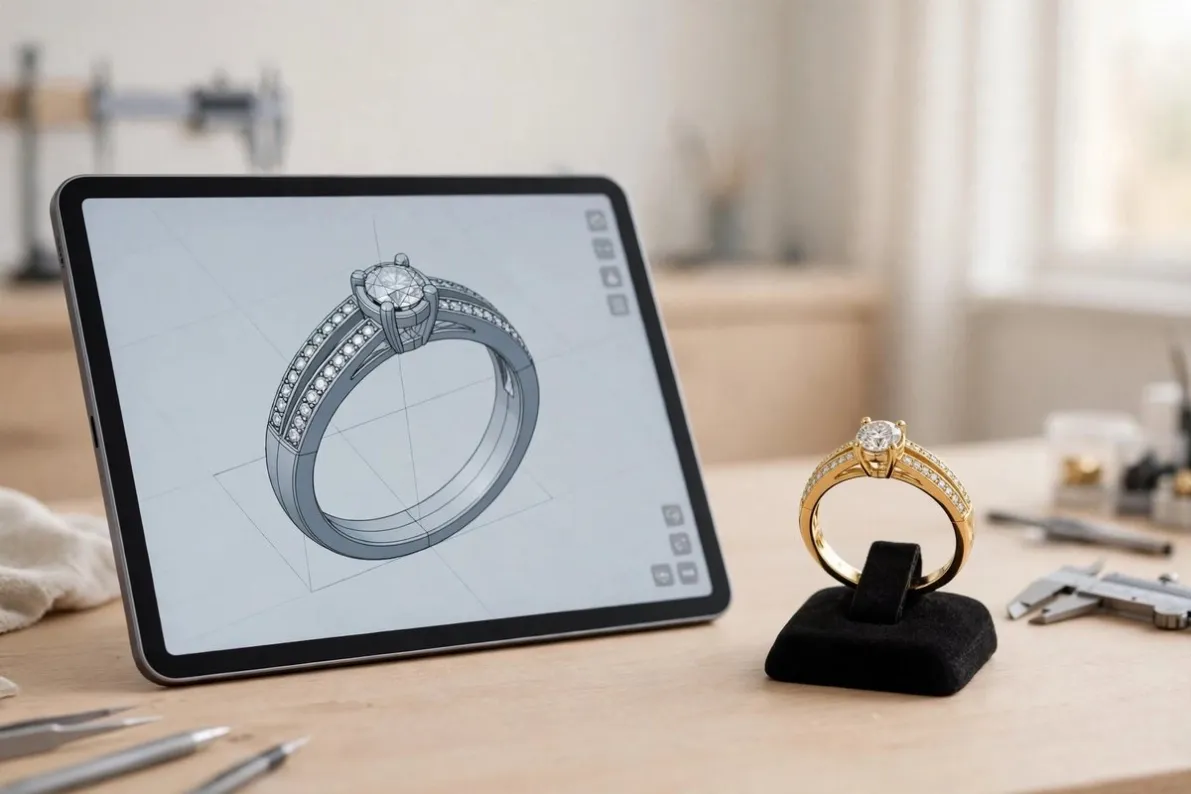
From Your Collection to the Showroom: How Designs Become Display Dummies
Quick answer: A collection becomes a display dummy line in five stages: map the collection, start from what you already have, engineering review, golden-sample approval, and batch production rolled out in waves. Replication can start from CAD files, technical drawings, product photos or a physical sample — a brand does not need to create or redesign anything. Designs are protected by an NDA signed before files move, with tooling and file ownership stated in writing. Sample approval comes before any batch: the approved sample — the golden sample — becomes the standard every later piece and every later wave is measured against.
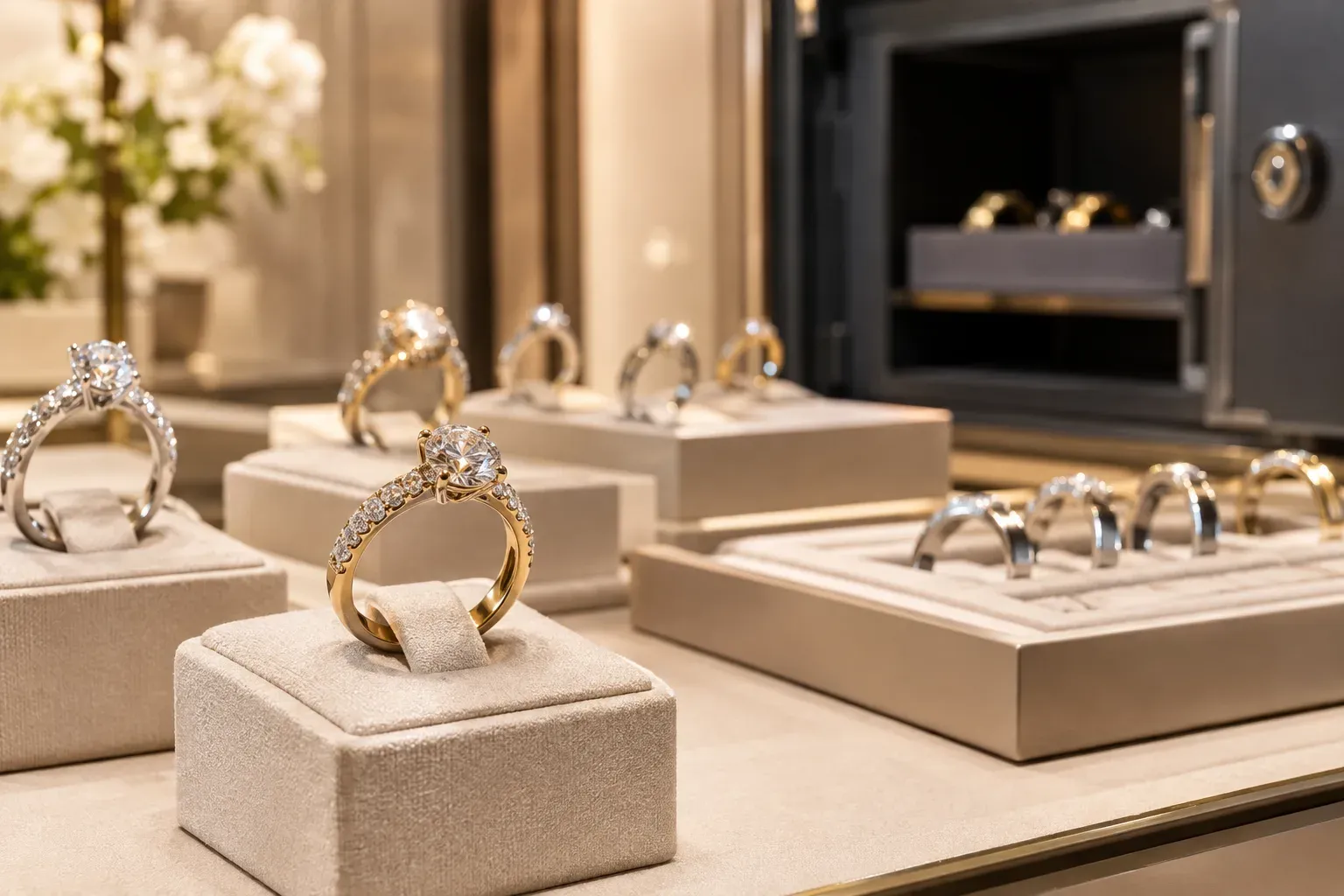
A display dummy program does not ask a brand to redesign anything. The real collection — dozens of designs, men's and women's, across finishes — is replicated as brass dummies so the showroom can show everything while the vault holds the originals. This guide walks through how a collection, whatever its size, becomes a matched display line: where replication starts, what engineering review actually checks, why sample approval is the step that protects the whole program, how designs are kept safe, and how a full collection rolls out without an empty case or a closed store.
In this guide:
- Step 0: Map the collection before anything is made
- What can replication start from?
- What happens in the engineering review?
- Why does sample approval matter?
- How is batch production kept consistent?
- How is the collection protected?
- How does a full collection roll out?
- Frequently asked questions
Step 0: Map the Collection Before Anything Is Made
Before replication starts, the collection is mapped design by design: every design, in every tone and finish it is sold in, with its display role noted. This mapping sheet is the program's master document.
A collection is not a pile of rings; it is a matrix. One design may exist in three tones and two finishes; another only in one. The mapping exercise records, for each design:
| Field | What it records | Example entry |
|---|---|---|
| Design reference | Your own design code or name | "Design 014 — pavé band" |
| Tones | Gold-tone, rose gold-tone, white gold-tone — as sold | Gold-tone + white gold-tone |
| Finish per tone | Polished, satin, brushed, textured | Polished shoulders, brushed centre |
| Stone layout | Unset, plain stones, or fully set to the original | Fully set |
| Display role | Case hero, standard case, counter try-on, photography, archive | Case hero |
| Size plan | One standard display size per design, or counter size run for core designs | Display size |
Two things come out of this step. First, the true scope of the program — programmes are counted in design-and-tone combinations, not in "a collection" as a vague whole. Second, the priorities for rollout (see the waves below): heroes and high-value designs are visible from day one of the mapping, not discovered halfway through production. The six specifications behind each row are detailed in the display ring dummy spec guide.
What Can Replication Start From?
Replication can start from any one of four starting points — whichever the brand already has. A brand does not need to prepare anything new; the same files and photos the collection already exists in are enough to begin.
- CAD files — the design files from the original production. The most complete starting point: dimensions, profile and stone layout are already defined.
- Technical drawings — dimensions and details on paper. Sufficient for most band and setting designs.
- Product photos — catalogue or e-commerce photography, with key dimensions confirmed with the brand. The right route for older collections whose files no longer exist.
- Physical samples — a real piece sent to the manufacturer, measured and replicated, and returned. The fallback that always works, and the reference other starting points are checked against at sample stage.
Different designs in the same collection often start from different points — current lines from CAD, archive lines from photos, a flagship from the physical piece. The programme handles the mixture; what matters is that every design converges on the same sample-approval standard.
What Happens in the Engineering Review?
In the engineering review, the manufacturer's engineers compare each design against what display use requires, and resolve every open question before anything is made.
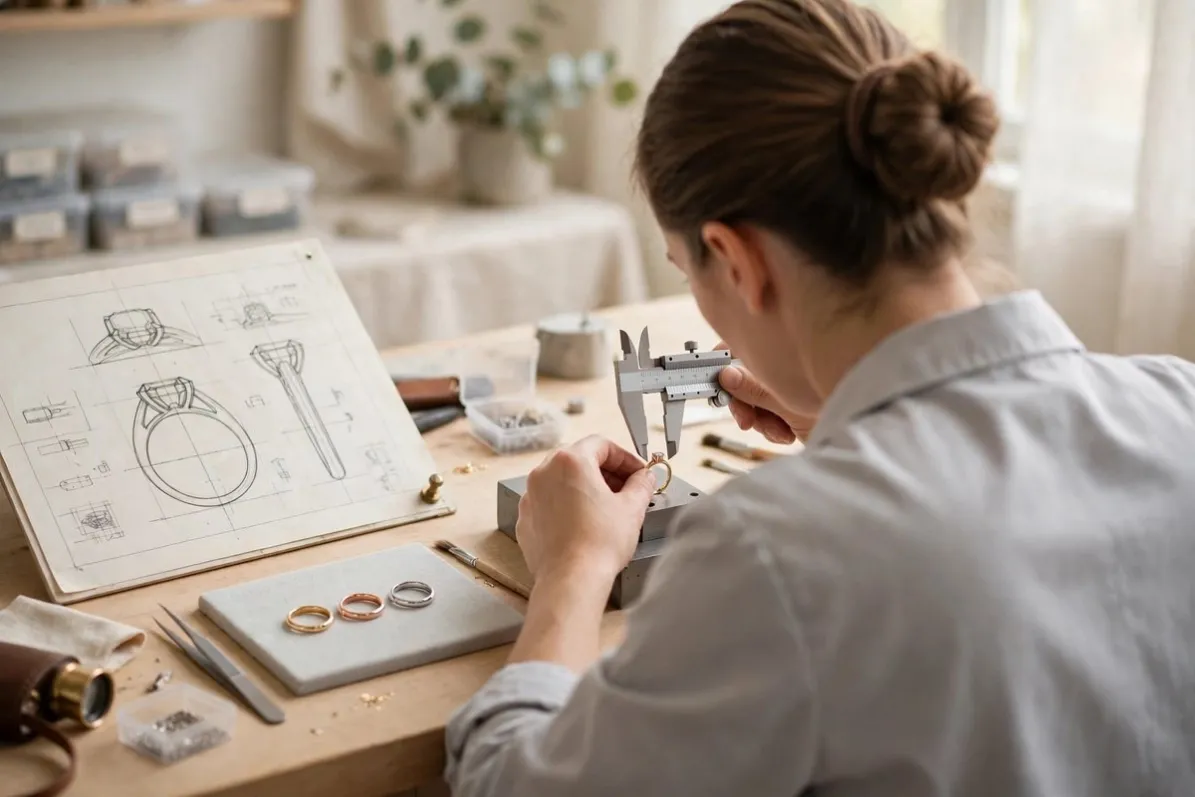
- Dimensions — width, profile and wall details reproduced so the dummy handles like the original on the hand and in the case.
- Stone layout — set positions mapped for real setting work, not decorative approximation: the dummy will be set the way the original is set.
- Finish mapping — polished, satin, brushed or textured, matched piece by piece and recorded against the mapping sheet.
- Tone assignment — gold-tone, rose gold-tone or white gold-tone per the real collection's colours, per design.
- Durability flags — a detail that will not survive display handling — an ultra-fine edge, a fragile raised element that will be handled daily — gets flagged here, with alternatives proposed and agreed with the brand.
Questions surface here, not in production. That sequencing is the entire discipline: a disagreement about a stone size or a finish boundary costs an email at review stage and a remade batch if it is discovered later.
Why Does Sample Approval Matter?
Every program starts with samples: one or more dummies made and compared against the originals under the brand's own lighting. The approved sample — the golden sample — becomes the standard the whole batch, and every later order, is measured against.
This is the same golden-sample discipline used in precious-metal production, and it is where a brand protects itself:
- Compare against the real piece, in your lighting. Tone and finish are approved side by side with the original, under showroom (and, for photography sets, studio) lighting — never from photographs of the sample alone.
- Check what customers will check. Weight in hand, setting quality at close range, engraving and fine detail, edges and profile — the same markers set out in When a Low-Fidelity Dummy Costs You the Sale.
- Record the approval. The signed-off sample is retained as a physical reference by the manufacturer, and the approval is documented per design. "Approved" must mean a specific object exists that later pieces can be compared to.
- No batch before approval. A manufacturer who will start a set without an approved sample is asking the brand to accept the first batch as the sample — with the whole collection at stake instead of one piece.
The case will only ever look as good as the sample the program was approved on.
How Is Batch Production Kept Consistent?
Batch production is a comparison exercise: every piece is produced to the golden sample and checked against it — tone, finish, setting and detail — across the full set, not just at the start of the run.
Consistency is the manufacturing risk unique to collections. A single ring can be made beautifully by almost any competent workshop; a hundred design-and-tone combinations that must sit together in one case, in one tone family, with no piece reading brighter, duller or rougher than its neighbours, is a control problem. It is managed three ways:
- One standard — the golden sample per design, not a written description of it.
- Set-level checking — pieces are compared within the set and against the sample before dispatch, because the customer will see them within the set.
- A retained reference for reorders — when a store later replaces a worn piece or a new dealer set is produced, it is made and checked against the same retained standard, so a set bought in waves still reads as one set (see Section 6 below).
How Is the Collection Protected?
Replication means sharing designs, so protection is explicit, written and sequenced before work — not implied by good intentions.
- NDA first — a non-disclosure agreement is signed before files or samples move. Nothing about the collection changes hands ahead of it.
- Tooling and file ownership in writing — the agreement states that the brand's designs, files and the tooling made from them belong to the brand, and what happens to them at the program's end, including return of molds and files on request.
- Program scope defined up front — which designs, which sets, which uses (showroom, counter, photography, road kits) are covered, so there is no ambiguity about what the replicas may be made for.
- Physical samples returned — originals sent for replication are logged, used as references, and returned.
A manufacturer who treats these as routine paperwork is showing you how they handle every client's collection — including, by extension, how yours will be handled when the next brand asks questions.
How Does a Full Collection Roll Out?
Large programs roll out in waves, ordered by exposure and selling importance — so the brand keeps selling from real pieces while the display line fills in. No downtime, no empty cases.
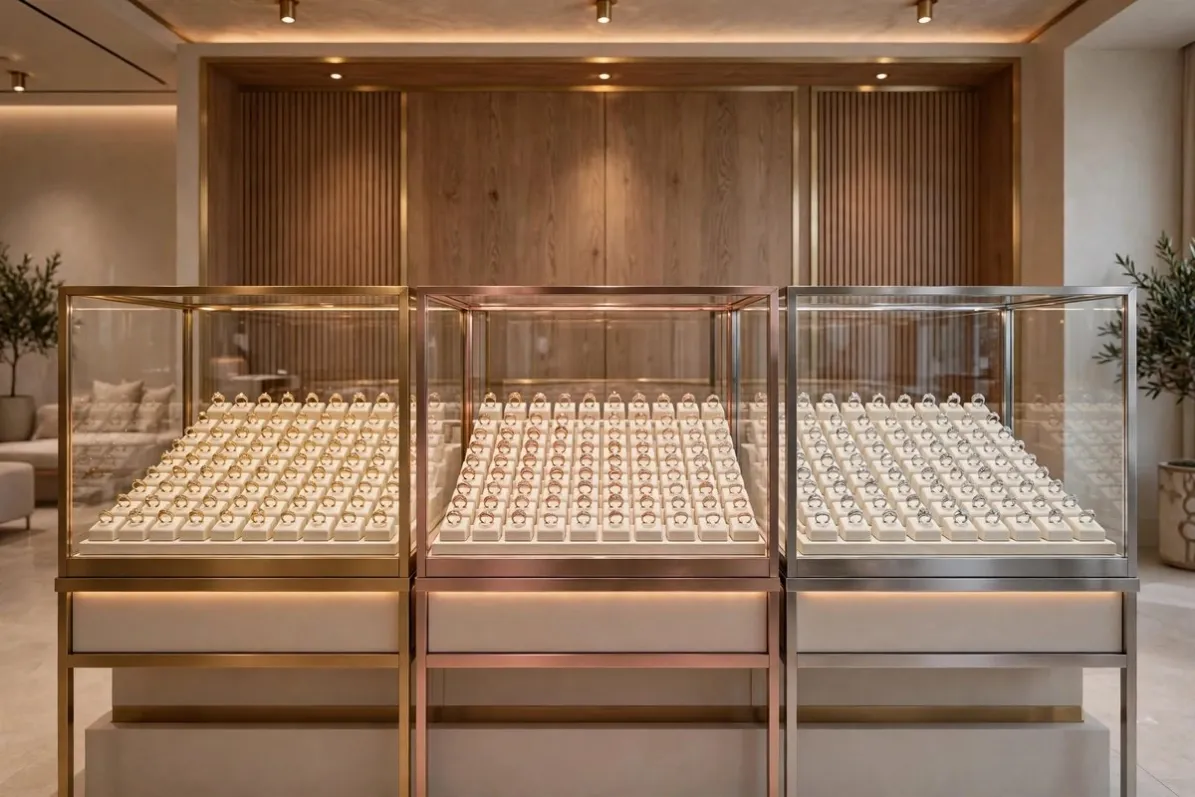
| Wave | Content | Logic |
|---|---|---|
| 1 | Hero and highest-value designs, window sets | Where security and insurance exposure is greatest, and where the brand is judged first (see the risk logic) |
| 2 | Full case sets for the first stores or dealers | The complete matched line, produced to the approved samples |
| 3 | Counter try-on sets | Core designs in size runs for the fitting counter (see the counter guide) |
| 4 | Photography, archive and travelling sets | The same standards extended to shoots, reference sets and road kits |
The order is a recommendation, not a rule: a brand launching a catalogue may put photography first; a multi-store network may roll store by store instead of program by program. What does not change is the mechanism — each wave is approved-sample-based, so wave four matches wave one, and the case is never emptied and refilled in a single risky swap. Stores trade normally throughout, presenting real pieces for closing while dummies progressively take over display duty.
Frequently Asked Questions
Do I need CAD files to replicate my collection as display dummies?
No. Replication can start from CAD files, technical drawings, product photos with confirmed dimensions, or a physical sample — whichever you already have for each design. CAD is the most complete starting point, but older collections are routinely replicated from photographs and samples. Nothing new needs to be created or redesigned to begin.
Will my designs be used for other customers?
No — that is what the program's written protections are for. An NDA is signed before any files or samples move, tooling and file ownership are stated in writing as the brand's, and the program scope defines exactly which designs may be produced and for what uses. Ask for all three in writing before sharing a collection; a professional manufacturer will offer them unprompted.
What is a golden sample in a dummy program?
A golden sample is the approved dummy for a design: made first, compared against the original piece under the brand's own lighting, and signed off as the standard. Every batch piece — and every later reorder, replacement and additional dealer set — is produced and checked against that retained physical sample, which is how sets made at different times still match.
What happens if a design detail cannot survive display handling?
It is flagged in the engineering review, before production, with alternatives proposed — for example a marginally reinforced edge or setting on the dummy that is invisible in the case but survives daily handling. The brand approves any adaptation at sample stage. Nothing about the design is changed silently during production.
How long does it take to replicate a full collection?
It depends on the size of the collection and how it is sequenced — which is why full collections roll out in waves rather than in one delivery. Heroes and high-value designs are produced first, so the showroom starts converting quickly while the rest of the line follows; the brand keeps trading from real pieces throughout, with no closed days and no empty cases. The sequence for your collection is agreed and written into the program before production starts.
Can I start with part of the collection and expand later?
Yes — wave-based rollout is designed for exactly that. Because every design is approved against its own golden sample and the samples are retained, later waves and additional sets are produced to the identical standard months or years later. Many brands begin with heroes and one flagship set, evaluate, then extend the program across stores and counters.
Who owns the molds and files made from my designs?
The brand. Ownership of the designs, the source files and the tooling made from them is stated in writing in the program agreement, including return of molds and files on request at the program's end. If a manufacturer will not state this plainly before work begins, do not send the collection.
About FKS Jewelry
FKS Jewelry is a custom ring manufacturer in Dongguan, China, making rings to the designs of jewellery brands, wedding-ring companies, wholesalers and product developers. FKS manufactures brass display ring dummies for gold and platinum jewellery brands — stone-set, micro-engraved, and finished in gold-tone, rose gold-tone and white gold-tone plating to match a real collection — alongside finished OEM rings in stainless steel, titanium, black titanium, tantalum, black zirconium, cobalt, Damascus steel and carbon fibre. Replication starts from a CAD file, a technical drawing, a product photo or a physical sample, with sample approval before batch production and work carried out under NDA.
Send your collection list — design by design, tone by tone — and discuss a rollout plan with our engineering team.
Related reading:
- Display Ring Dummies for Gold & Platinum Brands: A Spec Guide
- When a Low-Fidelity Dummy Costs You the Sale
- How Display Dummies Cut Theft, Insurance and Overnight Risk
- Why Brands Photograph Plated Brass Dummies Instead of Real Gold
- Counter Try-On and Sizing: Dummy Rings, Sizers and the Fitting Experience
- Brass rings and display samples — FKS Jewelry products
- Why stores display dummy rings instead of real stock