Tantalum Rings (Ta 999): The Premium Weight Metal — A Material Guide for Brands
Tantalum is the heavy, blue-grey, fully skin-safe metal that does not shatter. What Ta 999 means, why it costs more, how it wears, and how brands should range it.
Tantalum Rings (Ta 999): The Premium Weight Metal — A Material Guide for Brands
Quick answer: Tantalum is a rare, refractory metal whose jewellery grade is Ta 999 — 99.9% purity. It is roughly twice the weight of steel, naturally blue-grey, nickel-free and biocompatible (it is used in surgical implants), corrosion-proof, and tough rather than brittle — it bends where tungsten can shatter. It costs more than other alternative metals for two compounding reasons: the raw material is expensive, and it is hard on tooling, so machining is slow and process control is the real capability. This guide covers what brands need to know before adding a tantalum line; for how the rings are actually manufactured, see How Tantalum Rings Are Made.
Tantalum rings answer a specific brief: a dark, dense, premium men's band that feels expensive in the hand, is fully skin-safe, and does not shatter. Purity grading and machining difficulty set it apart from every other alternative metal — and demand from private-label brands keeps growing, from European gold-trade buyers to established wedding-band labels adding a contemporary ceiling tier. This guide covers the material end to end: what it is, why it costs, how it wears, and what designs it suits.
In this guide:
- What is tantalum, and what does Ta 999 mean?
- Why do tantalum rings cost more than other alternative metals?
- Is tantalum hypoallergenic?
- Properties at a glance
- How does tantalum wear over time?
- What designs work in a tantalum line?
- Frequently asked questions
1. What Is Tantalum, and What Does Ta 999 Mean?
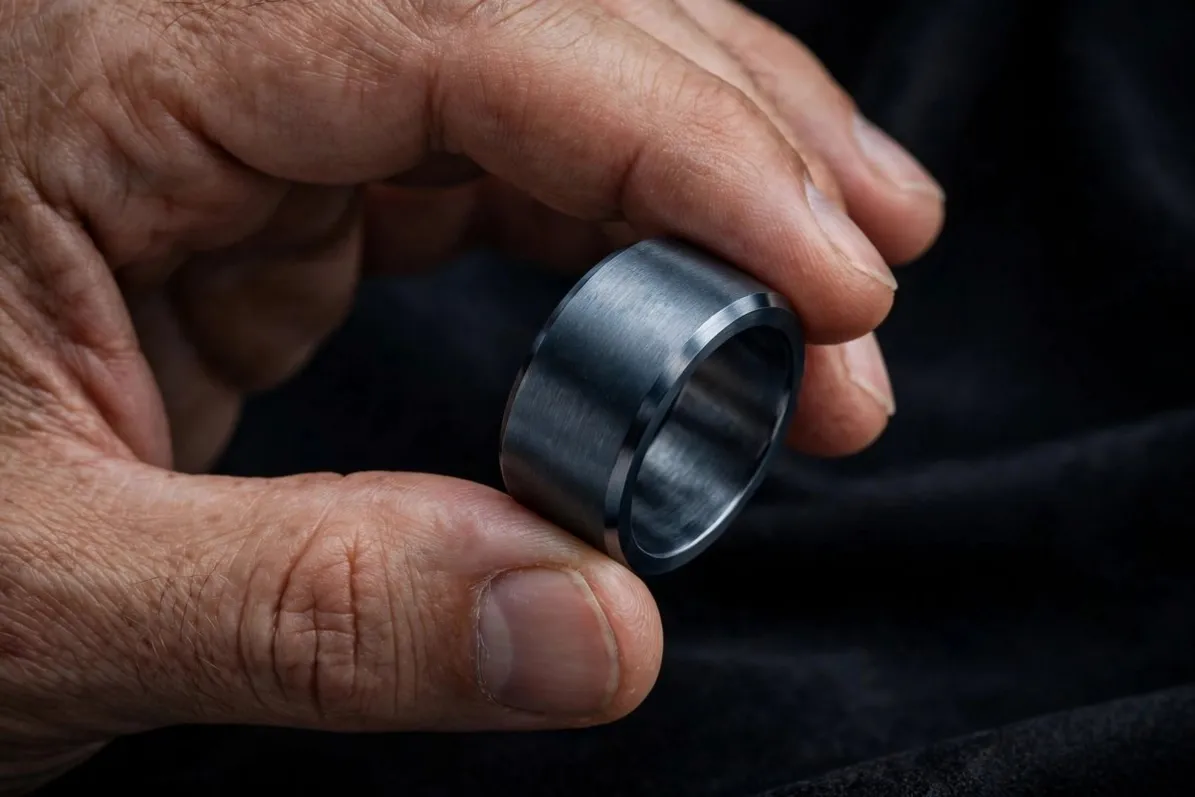
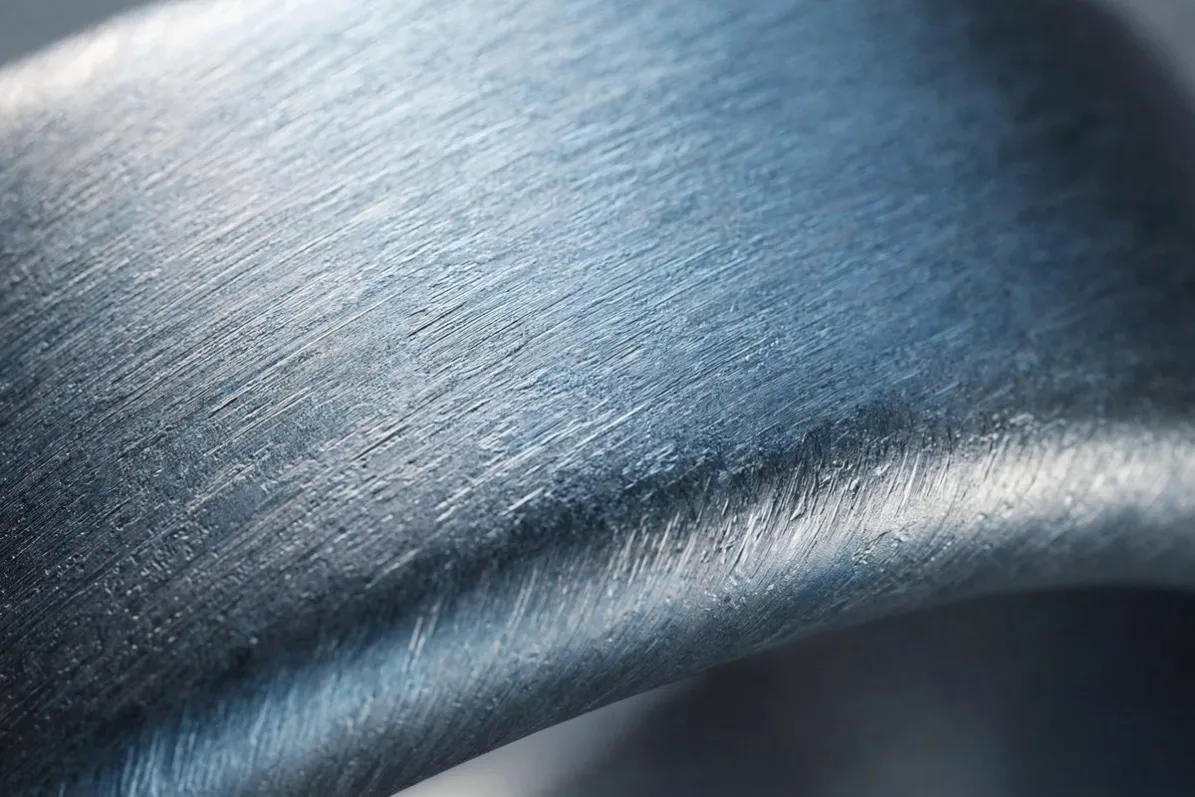
Tantalum is a refractory metal used in medical implants and electronics — capacitors are its famous industrial role — and Ta 999 denotes 99.9% purity, the grade relevant to jewellery. Visually it is a grey metal with a subtle blue tint that deepens under satin and brushed finishes; no coating creates the colour, and none is needed to keep it. Physically, its defining number is density: at about twice the weight of steel, a tantalum band lands in the hand with precious-metal presence — which is exactly what many premium men's customers want in a wedding band and cannot get from titanium. Because the metal also serves demanding industries, sourcing is a legitimate brand question: ask where a maker's tantalum comes from, and expect a documented answer.
2. Why Do Tantalum Rings Cost More Than Other Alternative Metals?
Two reasons stack, and honest brands explain both:
- Raw material cost. Tantalum is simply a rarer, more expensive metal than steel or titanium, and jewellery competes for it with medical and electronics demand.
- Machining difficulty. Tantalum is gummy under the cutter and wears tooling faster; cutting runs slower, and holding dimensional consistency across a batch demands disciplined CNC process control — sharp tooling, managed cutting, scheduled tool changes. (The full process: How Tantalum Rings Are Made.)
The conclusion a brand should draw: a factory that machines Ta 999 consistently is demonstrating real process capability, not just material access. The premium is explainable to customers in one sentence — rare metal, hard machining — and materials with explainable premiums are the ones premium retail can actually sell.
3. Is Tantalum Hypoallergenic?
Yes — highly biocompatible. Tantalum is used in surgical implants, contains no nickel, and is routinely recommended in metal-sensitivity discussions alongside pure titanium. Its corrosion resistance keeps the surface inert against skin, sweat and water indefinitely. For a premium men's line marketed to sensitive-skin customers, tantalum is one of the safest choices available — and one of the few heavy metals of which that can be said without qualification.
4. Properties at a Glance
| Property | Tantalum (Ta 999) |
|---|---|
| Purity grade | 99.9% (Ta 999) |
| Colour | Natural blue-grey; no coating |
| Weight | About twice steel — precious-metal heft class |
| Skin compatibility | Nickel-free, biocompatible, implant-grade history |
| Behaviour under extreme force | Bends; does not shatter |
| Corrosion | Essentially proof in daily wear |
| Resizing | Not possible — accurate sizing plus size exchange is the policy |
| Emergency removal | Cut with standard ring-cutting tools (slower than precious metal) |
| Finish development | Marks soften into patina over years; maker refinishing restores |
| Manufacturing | Machined from solid stock — not cast (melting point around 3,000 °C) |
5. How Does Tantalum Wear Over Time?
Tantalum is tough rather than brittle: it resists the cracking and shattering that tungsten can suffer on hard impact, because the metal yields instead of fracturing. On the surface, expect honest wear: fine marks develop over years into a natural patina and a softening of the finish — a look many customers actively want, and one brands should describe as character, not damage. There is no colour to lose, because there is no coating; a maker refinish restores the original surface for customers who prefer it new.
On sizing, the rule is the simple one, shared with every contemporary metal in this range: tantalum rings cannot be resized. Accurate sizing at purchase plus a clear size-exchange policy is the brand answer, stated up front — the same discipline as titanium, cobalt chrome and black zirconium, with no exceptions claimed.
Buyer discussions in wedding-planning communities summarise the appeal in their own terms: heavy in the hand, keeps its character, feels more scratch-tolerant than expected day to day, and a premium alternative to gold-level spending. Brands will note the pattern — the appeal is substance: weight, toughness and a colour that is the metal itself.
6. What Designs Work in a Tantalum Line?
- Heavy men's bands — wider profiles (the 6–10 mm class) where the weight reads as quality and the band is bought for its presence.
- Brushed and satin finishes — the finishes that deepen the blue-grey and age into patina most gracefully.
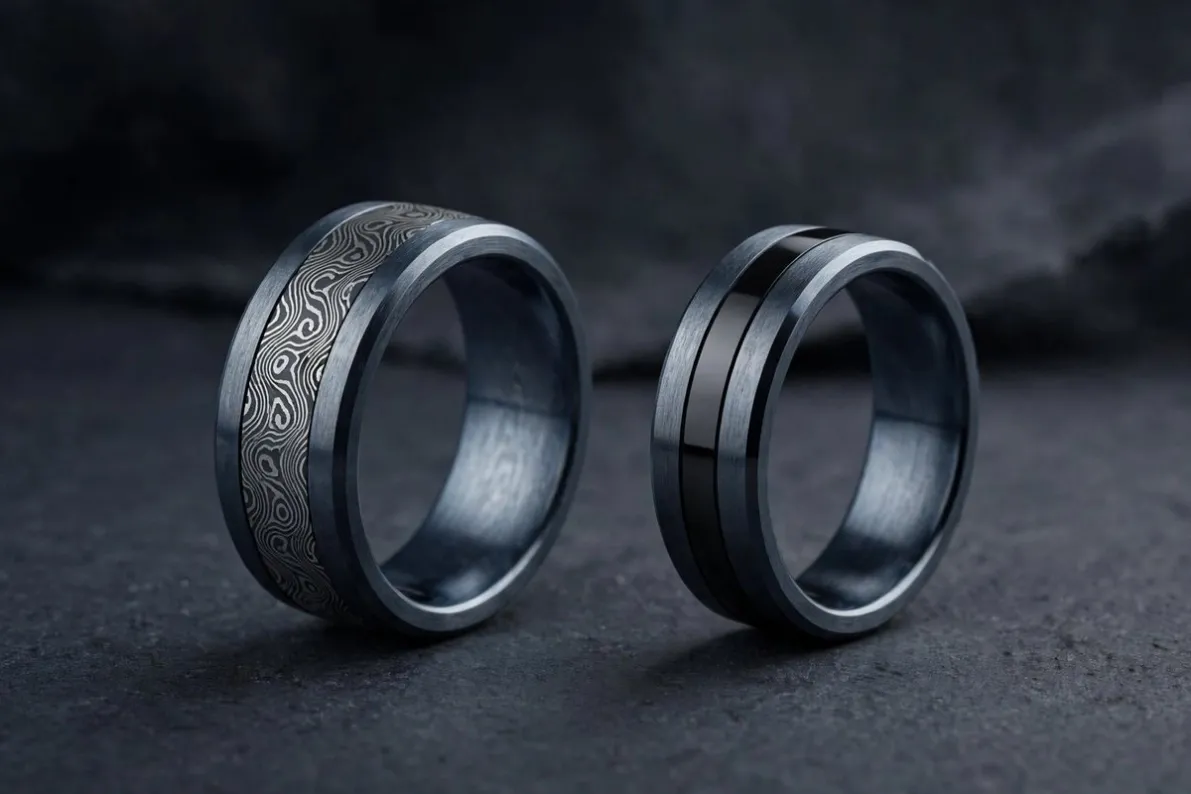
- Two-tone and inlay pairing — Damascus steel or black zirconium inlays across the tantalum ground: two FKS contemporary materials in one design language, pattern against dark.
- Stone-set statement pieces — the dark metal frames a setting dramatically, with seats machined to dimension.
- Engraved designs — crisp machined lines that the metal's density gives unusual depth.
A tantalum tier gives a collection a genuine ceiling piece — the band for customers who want substance, not just colour. Range it at the top, say plainly why it sits there, and let customers pick it up: this is the one material in the contemporary group that sells itself in the first three seconds of being held.
Frequently Asked Questions
What does Ta 999 mean?
Ta 999 is the purity designation for jewellery-grade tantalum: 99.9% pure tantalum. It is the grade used for rings — the same material family trusted in surgical implants and electronics — and the designation a brand should see stated plainly in any tantalum program's specification.
Why is tantalum so heavy, and why does it matter?
Tantalum is one of the densest metals used in jewellery — roughly twice the weight of steel, in the same heft class as precious metals. It matters because weight is the first quality signal a customer reads in the hand: a tantalum band feels substantial in a way light metals cannot imitate. Premium men's customers are, in large part, buying that feeling.
Tantalum or tungsten — which should a customer choose?
On toughness, tantalum: it bends under extreme force where tungsten carbide can crack or shatter on impact, and it can be cut off with standard tools in an emergency. On absolute scratch resistance, tungsten's surface is harder. On weight they are neighbours; on colour, tantalum offers a natural blue-grey tungsten does not. The honest steer: active hands and premium feel point to tantalum; a single-minded scratch brief points to tungsten, with the brittleness trade stated.
Tantalum or titanium?
They are opposite ends of the contemporary range. Titanium is the lightest ring metal and the natural choice for customers who want to forget they are wearing a ring. Tantalum is the heavyweight — precious-class presence, blue-grey colour, a ceiling-tier position. Most collections range both and let the hand decide; few customers are genuinely torn between them once they have held each.
Can a tantalum ring be resized?
No. Tantalum rings cannot be resized, like every other contemporary metal in this range. Brands should run clear size-exchange policies as the standard answer, alongside careful sizing at purchase — confirmed sizes, confirmed twice, are the whole strategy.
How do you care for a tantalum ring?
Simply: warm water, mild soap and a soft cloth. No coatings mean no coating care; no tarnish chemistry means no anti-tarnish products. Surface marks over the years are the patina the material is known for, and a maker refinish restores the factory surface whenever a customer wants the clock turned back.
Is tantalum a good choice for a wedding band?
Yes, for the customer it suits: someone who wants a dark, substantial band with precious-class weight, full skin safety, and toughness that forgives an active life — and who accepts patina as character. It is less suited to customers who want the lightest possible ring (steer them to titanium), a mirror-bright white metal (cobalt chrome), or a ring that can be resized later (precious metals — no contemporary metal offers resizing).
About FKS Jewelry
FKS Jewelry is a custom ring manufacturer in Dongguan, China, making rings to the designs of jewellery brands, wedding-ring companies, wholesalers and product developers. FKS machines tantalum (Ta 999) rings in-house — CNC turning, detail work, finishing and stone setting under controlled processes — within its finished OEM ring program across nine materials: stainless steel, titanium, black titanium, tantalum, black zirconium, cobalt, Damascus steel and carbon fibre for finished rings, plus brass for display samples. Programs start from a CAD file, a technical drawing, a product photo or a physical sample, with sample approval before batch production and work carried out under NDA.
Bring your premium men's line brief, and discuss a tantalum program with our engineering team.
Related reading: