Wedding Band Trends Heading Into 2027: What Brands Should Stock
Five wedding band trend signals for 2027 — spinner rings, tiered black bands, alternative metals, men's lines and honest stories — and the stocking move each implies.
Wedding Band Trends Heading Into 2027: What Brands Should Stock
Quick answer: Five wedding band directions are visible heading into 2027 in public, checkable places — social platforms, buyer communities and trade reporting. Spinner rings sold as fidget jewellery have become a real category; black bands have settled into three honest material tiers; couples compare alternative metals against gold at the wedding counter; men's rings have become a dedicated line rather than an afterthought; and buyers visibly reward brands whose material stories are honest. Each signal maps to a concrete stocking decision, set out below.
Contents
- How to read these signals
- Trend 1: Spinner rings go mainstream
- Trend 2: Black bands keep compounding — in three tiers
- Trend 3: Alternative metals reach the wedding counter
- Trend 4: Men's rings are a line, not an afterthought
- Trend 5: Honest material stories sell
- Frequently Asked Questions
- About FKS Jewelry
- Related reading
How to read these signals
Trend articles are only useful when the signals are real, so a note on method before the list. Nothing below rests on a single post or a single season. Each direction is visible in at least two independent places: content circulating on social platforms, the questions buyers ask repeatedly in community discussions, the way marketplace listings segment their collections, and trade-press commentary on where lines are expanding. Where a claim cannot be checked that way, it is not in this article — and no market sizes or percentages are quoted, because none are publicly verifiable.
Read the five trends as signals, not guarantees. A signal tells a brand where to place a considered bet: a line extension, a tier added, a fixture changed. The stocking move after each trend is deliberately modest — these are program adjustments, not reinventions.
Trend 1: Spinner rings go mainstream
Spinner rings — a fixed inner band with a freely rotating outer band — have moved from novelty to visible category. On social platforms, short videos of spinning bands circulate widely; the style is marketed and sold under the retail name "anxiety ring" and described by sellers and wearers as fidget jewellery. Trade commentary has picked the category up as one of the few genuinely new ring forms of recent years, with younger buyers as its most visible audience.
Two things make this more than a moment. First, the product has a heritage that predates the current attention: rotating-band "meditation rings" have been made for decades, so the form is proven even if the name is new. Second, the mechanism is a manufacturing discipline, not a styling trick — a spinner that drags or rattles reads as broken, so the brands that keep the category will be the ones whose spin fit holds across a batch, which is exactly the subject of our spinner ring manufacturing guide.
Stocking move: a 316L stainless steel spinner line as the volume entry — the material the category's proven programs are built on — sampled for spin feel before any range is committed.
Trend 2: Black bands keep compounding — in three tiers
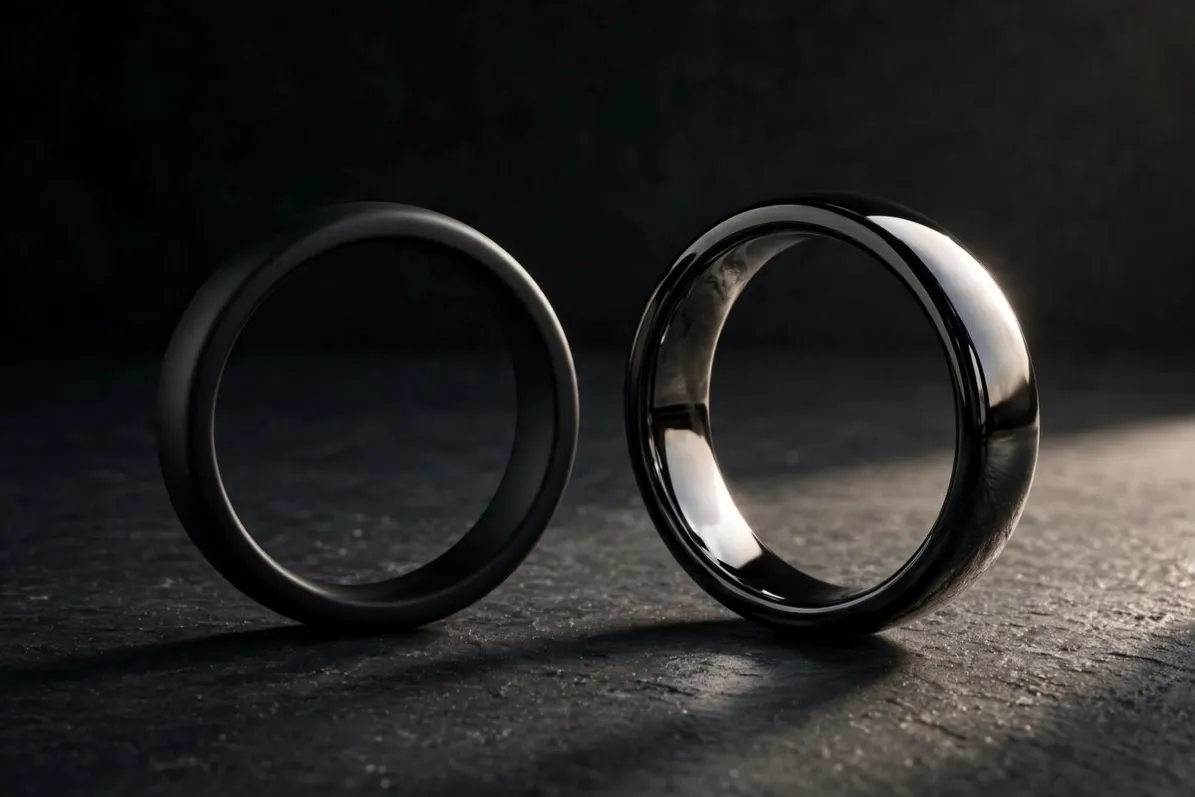
Black is no longer a niche look at the wedding counter; it is a standing section of the men's band wall. What has changed heading into 2027 is the market's fluency: buyers now discuss which black they are buying, because "black" is three different products. Black zirconium's colour is the metal's own oxide layer, integral and permanent short of a deep gouge. Black titanium is a distinct dark material route with a lightweight feel. Black-finish 316L carries its colour as a coating over steel — the accessible entry look, with a coating's wear story. Community discussion compares these routes knowingly, and listings increasingly segment black collections by material rather than by shade.
The trend risk is not stocking black; it is stocking one black and telling all three stories about it. Brands that blur the tiers collect the returns and reviews the blur deserves; brands that label each tier truthfully convert the fluency into trust. The full tier map is in our black wedding bands trend report and the black zirconium material guide.
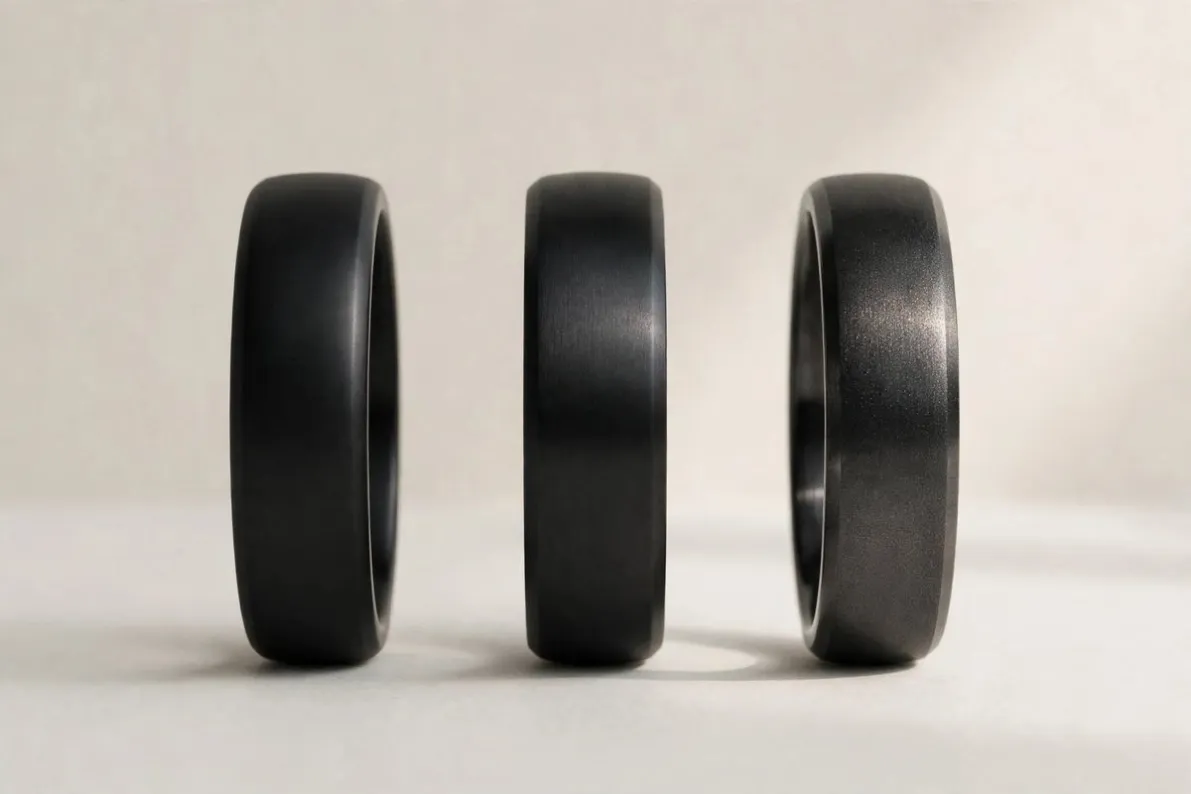
Stocking move: a tiered black program — at minimum two of the three routes — with product copy written per tier, never one vague "black ring" story stretched across all of them.
Trend 3: Alternative metals reach the wedding counter
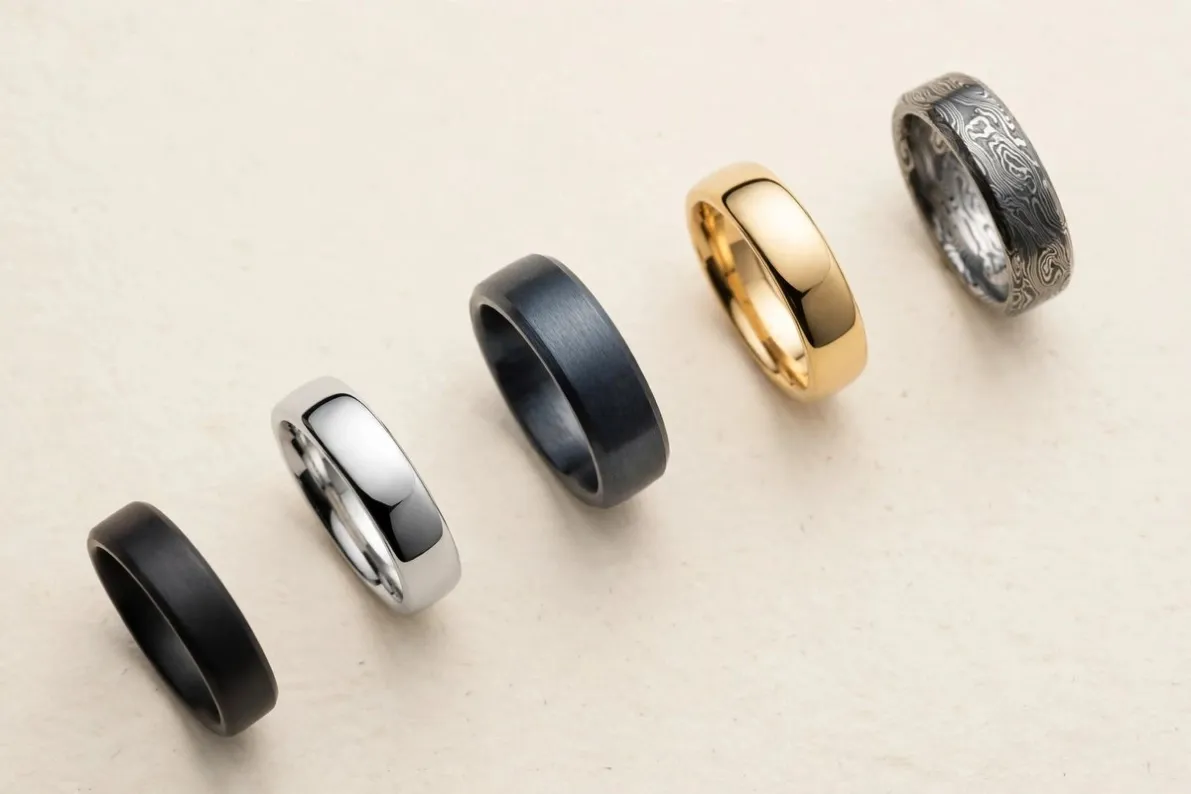
Couples now arrive at the counter already comparing titanium, tantalum and cobalt chrome alongside gold — weighing weight, colour and care in community discussions with a fluency that barely existed a few years ago. The comparison questions are practical: how heavy is it on the hand all day, is the white colour bright or grey, what does it do when it scratches, and can it be resized (for the machined alternative metals, it cannot — a fact to state at the counter, not after the sale).
For brands, the shift is structural: the wedding appointment is now partly an alternative-metals appointment, and a counter that can only answer in gold loses the couples who came in asking about tantalum. A complete ladder — 316L at the accessible end, cobalt chrome for the bright white answer, titanium for the lightweight answer, tantalum and black zirconium at the premium dark and heavy end — lets one fixture answer every comparison the couple brings in. Our tantalum material guide and 316L volume guide map the two ends of that ladder.
Stocking move: build the alternative-metal ladder as a deliberate wedding fixture, with a one-line honest answer per metal for weight, colour and resizing, printed where staff can use it.
Trend 4: Men's rings are a line, not an afterthought
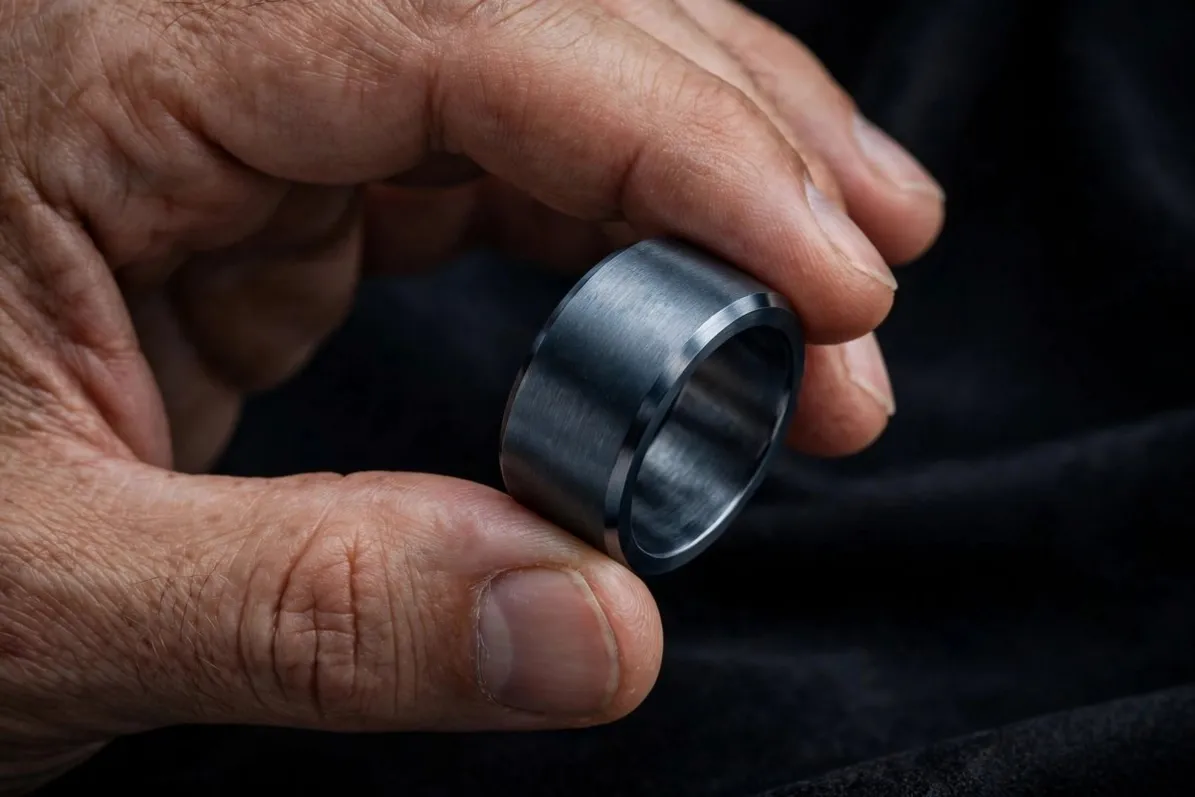
Men's bands and statement pieces keep expanding as a category: wider profiles than the traditional narrow band, signet and motif forms moving from niche to standard range items, engraved and textured surfaces, and two-tone builds that pair a dark body with a contrasting edge or inner band. The buyers asking for them skew younger and frequently buy for themselves, which changes the merchandising: men's rings earn their own fixtures, their own width range and their own photography, rather than the bottom shelf of the wedding case.
Width is the quiet part of this trend. A men's program that stops at standard widths misses the demand that is actually growing — broader statement widths worn as the single piece of jewellery. Texture travels with width: brushed, hammered and matte finishes read at macro distance on a wide band in a way they cannot on a narrow one. The design categories are mapped in our signet and motif ring guide.
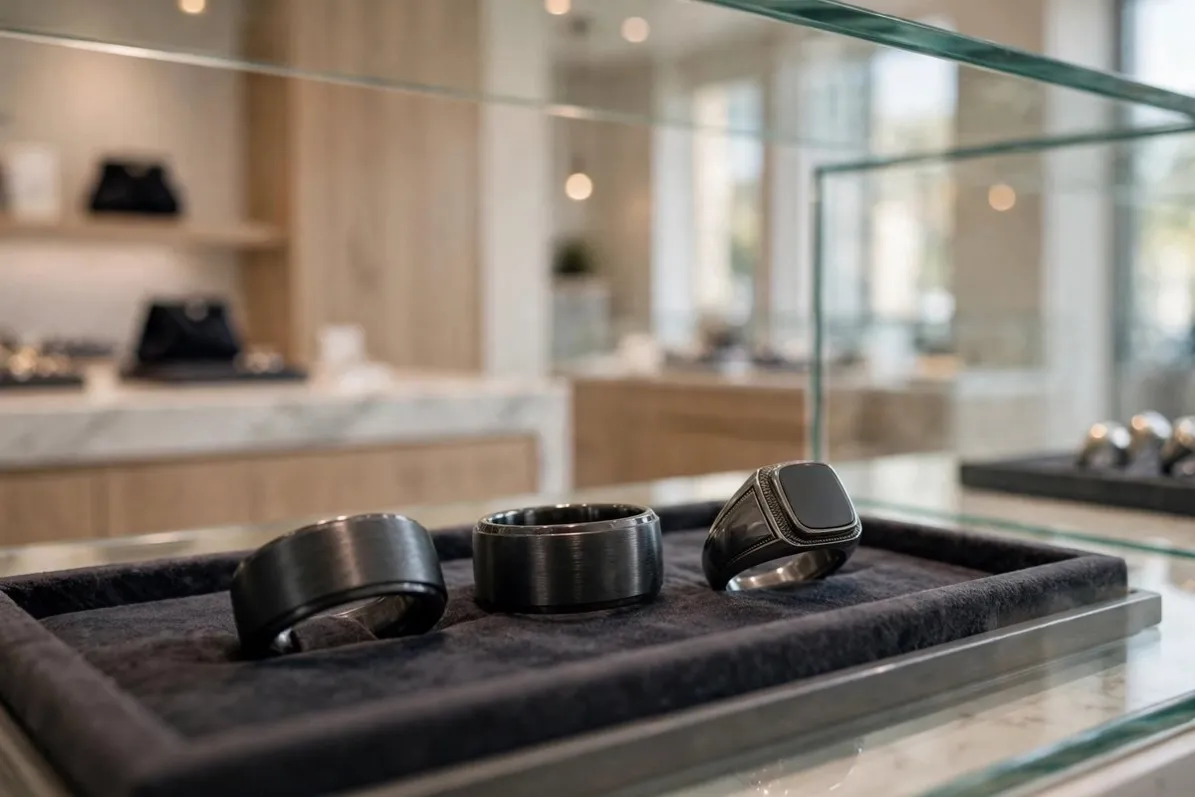
Stocking move: a dedicated men's fixture with a genuine width range and at least one statement family (signet or motif), photographed at macro scale the way buyers actually view them.
Trend 5: Honest material stories sell
Across all four trends runs one meta-pattern: buyers reward brands that state limits plainly. Which metals cannot be resized. Which colours are the material itself and which are a coating that can wear. What scratches softly, what cracks, what re-polishes. Community discussion amplifies both directions — honesty is quoted approvingly, and blurred claims are dismantled in public by buyers who know the materials.
This is, commercially, the easiest trend to join and the most expensive to skip: it costs nothing but accurate product pages. Name the grade — 316L, pure titanium, Ta 999 — rather than the family nickname. Name the colour source — oxide layer, material route, coating — rather than "black finish." State the sizing answer — these metals are exchanged in size, not resized — on the product page, not in the returns policy. Brands whose pages answer the four or five questions buyers actually ask convert the trend traffic the other four trends generate.
Stocking move: audit every wedding band product page for grade, colour source and resizing answer; the pages that name all three are the ones the 2027 buyer trusts.
Frequently Asked Questions
What are the biggest wedding band trends heading into 2027?
The biggest wedding band trends heading into 2027 are spinner rings moving into the mainstream, black bands organised into three material tiers, alternative metals being compared at the wedding counter, men's rings sold as a dedicated line, and honest material labelling as a selling point. Each is visible across social platforms, buyer communities and trade reporting rather than in a single source, and each maps to a specific stocking decision for a ring brand.
Are black wedding bands still trending for 2027?
Yes — black wedding bands remain a standing section of the men's wedding range heading into 2027, and the market has matured into tiers. Buyers now distinguish black zirconium, whose colour is the metal's own oxide, from black titanium as a distinct dark material route, and from black-coated 316L as the accessible entry look. The stocking implication is a tiered program with truthful copy per tier, not a single black product.
Why are spinner rings selling so well?
Spinner rings sell because the rotating band gives the wearer something to do with their hands, and the style is marketed and discussed as fidget jewellery — widely sold under the retail name anxiety ring. Short videos of spinning bands circulate heavily on social platforms, and the form has an older heritage in meditation rings, so the category rests on a proven product shape rather than a single viral moment.
Which alternative metals are couples comparing with gold?
Couples most often compare pure titanium, tantalum, cobalt chrome and 316L stainless steel with gold when choosing wedding bands. The comparison usually turns on weight on the hand, whether the white colour is bright or grey, scratch behaviour, care, and the fact that machined alternative metals cannot be resized. A counter that stocks the ladder and answers those questions plainly keeps couples who arrived asking about alternative metals.
Are wider men's wedding bands part of the 2027 trend?
Yes — wider profiles are a clear part of the men's wedding band trend heading into 2027, alongside signet and motif forms and textured or two-tone surfaces. Buyers skew younger and often buy for themselves, so men's rings increasingly justify a dedicated fixture, a genuine width range beyond the traditional narrow band, and macro-scale photography rather than space at the bottom of the wedding case.
How should a brand check a ring trend before stocking it?
A brand should check that a trend appears in at least two independent public places — circulating social content, repeated buyer questions in community discussion, marketplace collections segmented around it, or trade-press commentary — before committing stock. Signals that appear in only one place, or that come with precise market-size claims nobody can verify, should be treated as noise. Trends are stocking signals, not guarantees.
Can alternative metal wedding bands be resized?
No — machined alternative metal wedding bands in titanium, tantalum, cobalt chrome, black zirconium and 316L cannot be resized, and the correct service model is a size exchange. This applies across the trend materials in this article and should be stated on the product page and at the counter before purchase, because couples comparing against gold often assume resizing is available.
About FKS Jewelry
FKS Jewelry is a Dongguan-based custom ring manufacturer producing finished OEM rings for jewellery brands, wedding-ring companies, wholesalers and product developers, on a monthly capacity of 40,000–50,000 rings. Alongside brass display ring dummies — stone-set and micro-engraved, in gold-tone, rose gold-tone and white gold-tone plating — FKS machines finished rings in nine confirmed materials: 316L stainless steel, pure titanium, black titanium, tantalum, black zirconium, cobalt chrome, Damascus steel, carbon fibre and brass. Programs start from a CAD file, a technical drawing, a product photo or a physical sample; samples are approved before batch production, and client designs are handled under NDA. For trend-led lines, that means each of the directions above can be sampled and judged as a physical program before it is stocked.
Related reading
- Spinner Rings for Jewellery Brands: 316L Stainless Steel
- Black Wedding Bands: A Trend Report for Brands
- Black Zirconium Rings: Complete Material Guide
- Stainless Steel 316L Rings: The Volume Fashion Workhorse
- Tantalum Rings (Ta 999): Complete Material Guide
- Signet and Motif Rings in Alternative Metals